
Items
Tag
Alexander Hamilton
-
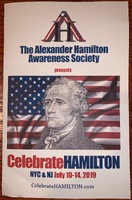 Program of Events - Celebrate Hamilton 2019 Printed program of events sponsored by the Alexander Hamilton Awareness Society in NY and NJ July 10-14, 2019 in commemoration of the 215th anniversary of the duel between Alexander Hamilton and Aaron Burr at Weehawken.
-
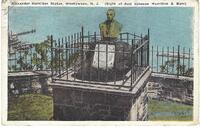 Alexander Hamilton Statue, Weehawken, NJ Color postcard of the Hamilton monument (pre-1935). It is not the site of the duel. Mailed May 1, 1917. Published by the Hudson Co., Union Hill, NJ
-
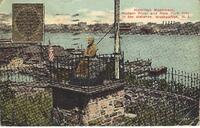 Hamilton Monument, Hudson River and NYC in the Distance, Weehawken, NJ Color photo postcard of the Weehawken monument, pre-1935 with the original plaque still on it. The text of plaque in upper left hand corner. Mailed September 21, 1914 from West Hoboken. Published by Brooklyn Post Card Co., Inc., New York
-
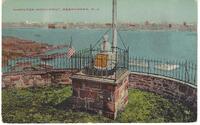 Hamilton Monument, Weehawken, NJ Colored postcard of the Hamilton monument, with Weehawken waterfront and New York skyline only partially colored. The bust of Hamilton is made of stone, therefore the image is dated to before 1935. The reverse is blank. Published by the Union News Company, New York. From the collection of Tony Bodtmann.
-
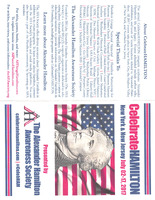 Program - Celebrate Hamilton 2017 Each July, the Alexander Hamilton Awareness Society presents a variety of events celebrating Hamilton's life. They also commemorate the anniversary of Hamilton's death fro wounds suffered in the famous duel here in Weehawken.This is the program for their 2017 events.More information:Alexander Hamilton Awareness Society
-
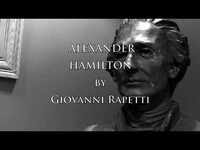 The Unveiling of the Bust of Alexander hamilton by Giovanni Rapetti - a short film by Michael Boldt Video of the unveiling of the newly recovered bust of Alexander Hamilton from the Hamilton National Bank. The bust now resides at the Weehawken Public Library.
-
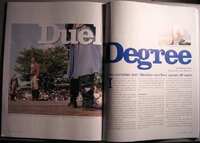 Columbia Magazine - Duel Degree Columbia Magazine (Winter 2004-2005) article entitled Duel Degree, which describes the re-enactment of the Hamilton Burr Duel held in Weehawken in July 2004. This item is in the collection of the Weehawken Historical Commission.
-
 The Alexander Hamilton Mixtape - The Duel in Rap Writer and star of the Broadway musical In the Heights, Lin-Manuel Miranda performs "The Hamilton Mixtape" at the White House Evening of Poetry, Music, and the Spoken Word on May 12, 2009. Accompanied by Alex Lacamoire.Watch this video on YouTube
-
 Video - Hamilton-Burr Duel Historical Panel - 2004 On July 11, 2004, Weehawken's Historical Commission held a re-enactment of the infamous duel between Alexander Hamilton and Aaron Burr, which took place in town 200 years earlier. The commemoration included a panel discussion held at Weehawken HS, in which prominent scholars and authors discussed the duel's place in history. This video, shot by C-SPAN, shows that discussion.Watch the video
-
 Video - Hamilton-Burr Duel Re-Enactment - 2004 On July 11, 2004, Weehawken's Historical Commission held a re-enactment of the infamous duel between Alexander Hamilton and Aaron Burr, which took place in town 200 years earlier. This video, shot by C-SPAN, shows the entire re-enactment.
-
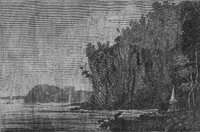 Engraving of Hamilton Monument - Undated Undated engraving of an early memorial to Alexander Hamilton at what was the site of the infamous duel.
-
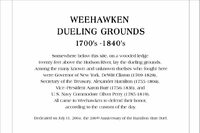 Commemorative Plaque - Weehawken Dueling Ground This plaque, placed to the right of the Hamilton monument at Hamilton Avenue and Boulevard East, commemorates the history of Weehawken's dueling ground. The text on the plaque reads: Weehawken Dueling Grounds (1700s - 1840s) Somewhere below this site, on a wooded ledge twenty feet above the Hudson River, lay the dueling grounds. Among the many known and unknown duelists who fought here were Governor of New York, DeWitt Clinton (1769-1828), Secretary of the Treasury Alexander Hamilton (1755-1804), Vice President Aaron Burr (1756-1836), and US Navy Commodore Oliver Perry (1785-1819). All came to Weehawken to defend their honor, according to the custom of the day. Dedicated on July 11, 2004, the 200th Anniversary of the Hamilton - Burr Duel.
-
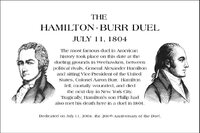 Commemorative Plaque - Hamilton Burr Duel This is an image of the historical marker which was unveiled just to the left of the Hamilton Monument on July 11, 2004, the bicentennial of the duel between Alexander Hamilton and Aaron Burr. The text on the plaque reads: The Hamilton Burr Duel July 11, 1804 The most famous duel in American history took place on this date at the dueling grounds in Weehawken, between political rivals, General Alexander Hamilton and sitting Vice-President of the United States Colonel Aaron Burr. Hamilton fell, mortally wounded, and died the next day in New York City. Tragically, Hamilton's son Philip had also met his death here in a duel in 1801. Dedicated on July 11, 2004, the 200th Anniversary of the Duel.
-
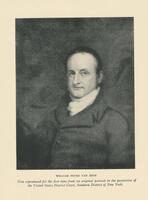 William Peter Van Ness William Peter Van Ness was Aaron Burr's second in the infamous duel with Alexander Hamilton, which took place in Weehawken on July 11, 1804. This engraving is from the book Aaron Burr; a biography written, in large part, from original and hitherto unused material, by Samuel H. Wandell and Meade Minnigerode. New York, Putnam, 1927. Thanks to Lauren Sherman of the Weehawken Historical Commission for this image.
-
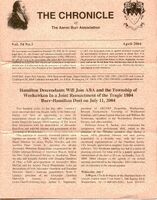 The Chronicle of the Aaron Burr Association - April 2004 This article from the April 2004 issue of The Chronicle of the Aaron Burr Association describes the ABA's plans for commemoration of the anniversary of the Hamilton-Burr Duel in Weehawken in July 2004.
-
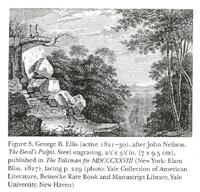 The Devil's Pulpit Copy of an engraving of The Devil's Pulpit, a spot on the Palisades in Weehawken, which has been mentioned as a possible site of the infamous duelling ground. Caption: George B. Ellis (active 1821-30) after John Neilson. The Devil's Pulpit Steel engraving 2 3/4 by 3 3/4 in. (7 x 9.5 cm) published in The Talisman for MDCCCXXVIII(New York: Elam Bliss, 1827) Thank you to Willie Demontreux of the Weehawken Historical Commission for providing this image.
-
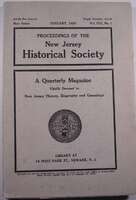 The Burr-Hamilton Duel - NJ Historical Society - Jan 1929 This is an article which appeared in Proceedings of the New Jersey Historical Society - January, 1929 The Burr-Hamilton Duel by Joseph Fulford Folsom starts on page 9 of the periodical. Thank you to Willie Demontreux for these images!
-
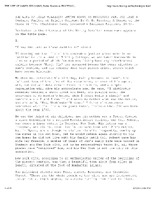 Professor Jim Recollects The Duel The attached document is a transcription of: THE LIFE OF JAMES WILLIAMS; Better Known as PROFESSOR JIM. For Half a Century, Janitor of Trinity College.By C. H. Proctor, A Member of the Class of '73.(Hartford: Case, Lockwood & Brainard Printers, 1873). In this document, 'Professor Jim' recollects about the duel. Thanks to Willie Demontreux for finding this link.
-
 The Case of Aaron Burr This file contains a number of documents related to what happened to Aaron Burr after his duel with Alexander Hamilton. The original compilation was created by the Tucson, Arizona Unified School District. Thanks to Willie Demontreux for finding this resource.
-
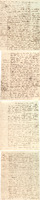 Letter from Alexander Hamilton to Harrison Gray Otis - 1800 This letter from Alexander Hamilton makes his feelings about Aaron Burr very clear - four years before the fateful duel at Weehawken. Image and transcription from the Gilder Lehrman Institute of American History. N York Decr. 23. 1800 Dr Sir, I lose no time in replying to your letter of the 17- this day received. My opinion is, after mature reflection, that if Jefferson and Burr come with equal votes to the House of Representatives, the former ought to be preferred by the [struck: House of Representatives] Federalists. Mr. Jefferson is respectably known in Europe - Mr. Burr little and that little not advantageously for [strike-out] a President of the U States. - Mr Jefferson is a man of easy fortune. - Mr. Burr, as I believe, is bankrupt beyond redemption unless by some coup at the expense of the public and his habits of expense are such that Wealth he must have at any rate. - Mr. Jefferson is a man of fair character for probity. - Very different ideas are entertained of Mr. Burr by his enemies and what his friends think, you may collect from this anecdote - A lady said to Edward Livingston ironically "I am told Mr Burr will be President. [2] I should like it very well if I had not [struck: been told] learned that he is a man without property." - "Let him alone for that," replied Edward, - "If he is President four years, he will remove the objection." - Mr. Jefferson, though too revolutionary in his notions, is yet a lover of liberty and will be desirous of something like orderly Government. - Mr. Burr loves nothing but himself - Thinks of nothing but his own aggrandizement - and will be content with nothing short of permanent power [struck: and] in his own hands. - No compact, that he should make with any [struck: other] passion in his [struck: own] breast except Ambition, could be relied upon by himself. - How then should we be able to rely upon our agreement with him? Mr. Jefferson I suspect will not dare much. Mr. Burr will * [inserted in margin: Dare every thing in the sanguine hope of affecting every thing.] If Mr. Jefferson is likely from predilection for France to draw the country into war on her side - Mr. Burr will certainly endeavor to do it for the sake of creating the means of personal power and wealth. [3] This portrait is the result of long and attentive observation on [sic] a [strike-out] man with whom I am personally well - and in respect to whose character I have had peculiar opportunity of forming a correct judgment. By no means, my Dear Sir, let the Federalists be responsible for his Elevation. - In a choice of Evils, let them take the least - Jefferson is in my view less dangerous than Burr. But we ought - still to seek some advantages from our situation. It may be advisable to make it [strike-out] a ground of exploration with Mr. Jefferson or his confidential friends and the means of obtaining from him some assurances of his future conduct. The three essential points for us to secure is. 1 The continuance of the neutral plan bonafide towards the belligerent powers 2 The preservation of the present System of public credit -- 3 The maintenance & gradual increase of our navy. Other matters may be left to take their chance. While I have my pen in [4] hand, I will express some ideas to you about the Convention with France - I am far from approving several of its features but I am clear that it ought now to be ratified having been negotiated & that the not doing of it would ruin the Federal party, hazard our internal tranquility, and leave the door open for a worse arrangement under the new Administration. One question will be whether this Treaty is compatible with our [struck: Federal] engagements to Great Britain. I hold it to be the better opinion that it is. It seems to me that the annulling of our Treaties with France is a matter between her and us by which another power ought, neither to gain nor lose - that in terminating those differences we might have gone back to the Status quo antebellum & make no power not put in worse situation than before would have a right to complain. Yrs with great afftn A Hamilton H.G. Otis. Esq
-
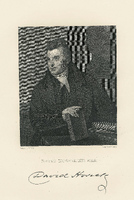 Engraving - Dr. David Hosak Engraving of David Hosack, MD, F.R.S., the physician who attended to Alexander Hamilton after his duel with Aaron Burr on July 11, 1804 in Weehawken, NJ. Eng. by A.B. Durand. From the collection of Lauren Sherman.
-
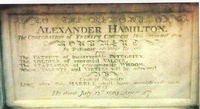 Inscription from Alexander Hamilton's Tomb After his fatal duel with Aaron Burr in Weehawken on July 11, 1804, Alexander Hamilton was laid to rest in Trinity Church Yard, located at Broadway and Wall Streets in Manhattan. This is a photograph of the inscription on his grave. Thank you to Willie Demontreux for this image.
-
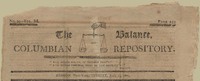 Newspaper Coverage of the Hamilton-Burr Duel The Balance and Columbian Repository, published in Hudson, New York, edition of July 24th, 1804. This newspaper contains Hamilton's obituary, reactions from the public as well as a copy of the correspondence leading to the duel. Click on link to view the following week's newspaper, in which the coverage and letters are concluded.
-
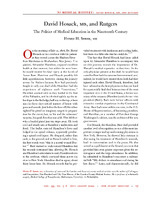 David Hosack MD and Rutgers This is an article about Dr. David Hosack, the doctor who tended to the wounds of Alexander Hamilton after his duel with Aaron Burr here in Weehawken on July 11, 1804. It was published in New Jersey Medicine, the journal of the New Jersey Medical Society (July-August 2002 - Vol 99, number 7-8). Thanks to Willie Demontreux for finding this article.
-
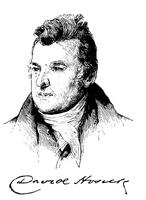 Dr. David Hosack Dr. David Hosack attended to Alexander Hamilton's wound after his duel with Aaron Burr. The following information, from The Princeton Companion was found by Weehawken Historical Commission member Lauren Sherman: Hosack, David Hosack, David (1769-1835), a leading physician of his day and an eminent botanist and mineralogist, had strong ties with both Princeton and Columbia. The son of a New York wine merchant who came to America to serve under Lord Jeffery Amherst in the French and Indian War, he attended Columbia for two years and then transferred to Princeton, where he received a bachelor's degree in 1789. He made the change partly to escape from the distractions of the city, and partly to obtain the benefits of instruction by the distinguished faculty then teaching in Nassau Hall -- "attractions,'' he said, which he "could not resist.'' He studied medicine, first in New York, then in Philadelphia, where he lived with the family of his favorite teacher Benjamin Rush 1760. He later studied medicine and botany in Edinburgh and mineralogy in London, bringing back from Great Britain the beginnings of a mineralogical collection that he later gave to Princeton. He was, successively, professor of botany and material medical at Columbia College, professor of the theory and practice of physic at the College of Physicians and Surgeons, and president of the short-lived Rutgers Medical College, which he helped found. Early in his career, he established "in the vicinity'' of New York -- actually where Rockefeller Center now stands -- the famous Elgin Botanic Garden, named for his father's birthplace in northern Scotland. Here each year at the end of the spring term, he held a strawberry festival, in order, he once told another teacher, to let his students see that he was practical as well as theoretical. "The fragaria is a most appropriate aliment,'' he reminded his skeptical colleague; "Linnaeus cured his gout and protracted his life by strawberries.'' Among those who partook of his strawberries and of his botanical knowledge was John Torrey, who later taught botany and chemistry at Princeton and Columbia. Hosack's circle of friends included Aaron Burr, Jr. 1772, and Alexander Hamilton. As the surgeon in attendance at their duel in 1804, he treated Hamilton after he was mortally wounded; and he was one of the pallbearers at Hamilton's funeral. Three years later, after Burr was tried for treason and acquitted, Hosack lent him passage-money to go abroad in order to escape the notoriety resulting from the trial. Princeton awarded Hosack an honorary LL.D. in 1818, and commissioned his portrait by Rembrandt Peale in 1826; it hangs in Upper Eagle Dining Hall. When his friend Bishop John Henry Hobart 1793 died in 1830, Hosack was elected to succeed him as a vice president of the Alumni Association of Nassau Hall, of which James Madison was then president. In his time, Hosack was considered one of New York's first citizens. He was influential in social and civic affairs as well as in his profession. He was a founder of the New York Historical Society and the American Academy of Fine Arts in addition to Bellevue Hospital, and "his house was the resort of the learned and the enlightened from every part of the world.'' According to one of his medical colleagues, it was often observed by citizens of New York that DeWitt Clinton, Bishop Hobart, and Dr. Hosack were "the tripod on which our city stood.'' From Alexander Leitch, A Princeton Companion, copyright Princeton University Press (1978).