
Items
Tag
police
-
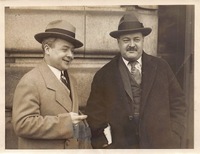 Photo - Weehawken Police Commissioner Harry Stearns and his attorney Caption: N 74583 "P & 4 PHOTOS"WATCH YOUR CREDIT (PHOTO SHOWS L to R HARRY STEARNS, POLICE COMMISSIONER OF WEHAWKEN, N.J., AND HiS ATTORNEY, CHARLES STUHR) INFORMER IN JERSEY RUM SCANDAL SWEARS HE SAW FOLICE HEAD CHECKING RUM LOADFATHER BENNETT FLASHED A POCKET LIGHT ON THEM AND WE BOTH RECOGNIZED A MAN WHO WAS ENGAGED IN COUNTING AND CHECKING OFF THE CASES OF LIQUOR AS HARRY J . O S' HAUGHNESSY STEARNS, POLICE COMMISSIONER OF WEEHAWKEN," SAID CHARLES D. KIRK, REPUBLICAN POLITICIAN OF WEEHAWKEN, N.J., IN AN AFFIDAVIT WHICH EXPOSED HIGHER-UPS IN THE JERSEY LIQUOR RUNNING SCANDAL. IT IS HINTED THAT FEDERAL PROHIBITION AGENTS, NEW YORK CITY POLICE OFFICERS AND OTHER JERSEY POLITICIANS MAY BE DRAGGED INTO THE SCANDAL.FM. 12-8-24According to a NY Times article (Wed, June 17, 1925), Stearns and 9 other Weehawken PD personnel were found not guilty of charges of violating the Volstead Act (Prohibition)
-
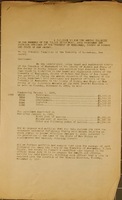 1954 Petition Regarding WPD Salaries A petition requesting pay raises for Weehawken Police Department personnel for the year 1955.
-
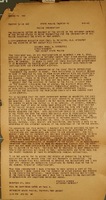 World War II NJ State Police Instructional Teletype - Limitations on radio ownership by 'enemy aliens' A teletype message from the NJ State Police in the files of the Weehawken Police Department from 1942 providing instructions as to the limitations placed on 'enemy aliens' of German, Italian, and Japanese origin regarding ownership of radio equipment. This document provides insight into the WPD's role in wartime preparedness.
-
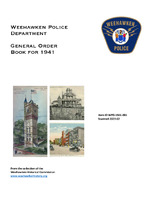 Weehawken Police Department General Order Book for 1941 Book containing department wide orders of a general nature for the year 1941 for the Weehawken Police Department. This document provides interesting insight into the Town's preparation for World War II as well as the reaction of its police department to the first days of this global conflict.
-
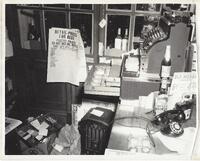 Crime scene - cash register and counter at drugstore 9" x 11" black and white photograph of cash register at crime scene
-
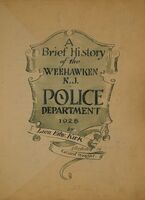 History of the Weehawken Police Department - 1928 Sketches and drawings related to the Weehawken Police Department in 1928, drawn by artist Grant Wright, with contributions of Police Lieutenant Edward Kirk.
-
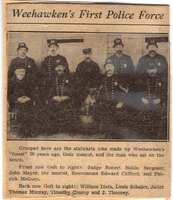 Weehawken's First Police Force Undated and unidentified newspaper clipping of a photo of Weehawken's first police department and their mascot. Front row (left to right): Judge Robert Noble Sergeant John Mayer the mascot Roundsman Edward Clifford Roundsman Patrick McGoey Back row (left to right): William Dietz Louis Schafer Jailer Thomas Murray Timothy Conroy J. Timoney This item is in the collection of the Weehawken Historical Commission.
-
 Dismantling Old Roman Mansion, Once Served as Weehawken Jail Clipping from an unidentified newspaper (probably the Hudson Observer) stamped March 21, 1947 and describing the demolition of 1 Hackensack Avenue in The Shades. This building was Weehawken's first Police HQ and Jail in 1870. The article provides a number of details about Weehawken's early law enforcement and hospitality communities.
-
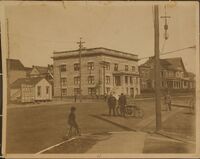 Policemen at 4th Street (48th Street) and the Boulevard This photo from the early 1900s shows Patrolman Sy. Clute of the Weehawken Police Department and Boulevard Officer Patrick Dolan, who later became chief of the Hudson County Police Department. It was taken at the corner of 4th Street (today's 48th Street) and Boulevard East.
-
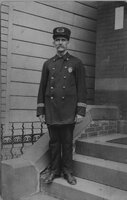 Police Captain A. Charles Hessner Police Captain Charles A. Hessner, posed on the stairs of the old town hall/police station at 309 Park Avenue, today's VFW and Historical Commission headquarters. From the collection of the Weehawken Historical Commission.
-
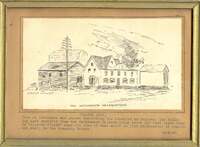 The Weehawken Headquarters Drawing of Weehawken's Police Headquarters and Township Prison. The caption reads: Created 1870 when an Ordinance was passed describing its location as follows: The Building next easterly from the Hackensack Pl. Road, being about 200 feet there from in "Elysian Fields" near the line of what would be 11th Street (Hoboken), if continued, shall be the Township Prison. The drawing is signed by Grant Wright and the typewritten caption is by Chief E.J. Kirk, Weehawken's Police Chief and historical devotee.
-
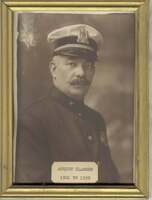 Photograph - August Klassen - Weehawken PD Chief 1921 - 1939 Black and white photograph of Police Chief August Klassen. He was born in Germany, came to NY as a child and moved to Weehawken in 1899, working his way up in the department. Klassen became Chief when Patrick McGann died in 1921. Weehawken resident Billy Rapacki found this photograph at a yard sale. We believe this photograph was part of Police Chief Edward Kirk's personal collection.
-
 Photograph - Patrick Mc Gann - Weehawken PD Chief 1907-1921 Patrick McGann served as Weehawken Police Chief, was also a member of the Weehawken Board of Health for several years and ran a popular saloon named for himself in the Shades. Weehawken resident Billy Rapacki found this photograph at a yard sale.
-
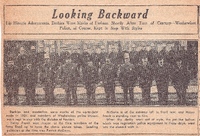 Looking Backward - Turn of the Century Weehawken Policemen Newspaper clipping (unknown date or paper) from the collection of Chief Edward Kirk ahowing Weehawken's finest and their spiffy uniforms and mustaches in 1901. Henry Frank was mayor at the time. Patrick McGann was "leading politician".
-
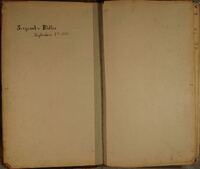 Weehawken Police Blotter (1898-1903) This desk blotter records the activities of the Weehawken Police Department and the people whom they served, protected and arrested from 1898 through 1903.
-
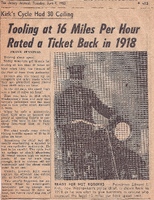 Tooling at 16MPH Rated A Ticket Back in 1918 This news clipping features a photo of Chief Ed Kirk (before he was Chief) on his motorcycle getting ready to run down anyone who dared speed through Weehawken's streets at the unheard of speed of 15 mph. Probably from the Jersey Journal.
-
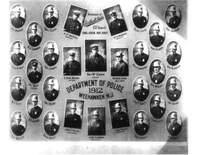 Weehawken Police Department 1912 This portrait of the men of the Weehawken Police Department in 1912 was donated by Peter Troost who notes... "There were 3 generations of FLOODS on the Weehawken Police Force. Robert Flood (pictured) his son David Flood, and David's son James. C. Verdon (pictured) was my wife's (Catherine/Katy Wey) grandfather, and also related to Chiecos, Verdons."
-
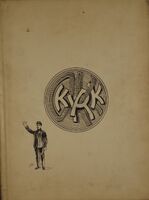 Sketchbook - For the Collection of Edward J. Kirk - Grant Wright - 1934 Sketchbook by artist, Grant Wright, made for his friend and historical colleague, Lt. Edward Kirk.
-
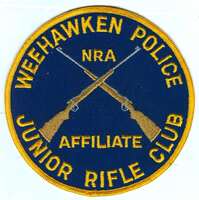 Weehawken Junior Rifle Club Patch Gold and Blue patch: Weehawken Police Junior Rifle Club, NRA Affiliate. According to Time Machine user John Haug (WHS '66)... The Weehawken Junior Rifle Club met in the attic of the Town Hall in the early 60s. There was a 50s pistol range there at the time. Capt Harry Decker and Lt George Willmott, I think, were adult advisors, and the members ranged in age from about 13-17, as I recall. As an affiliate of the NRA, the club acquired some .22 cal Mossberg target rifles from the Federal Gov't. We competed with some other clubs in the North Jersey area.
-
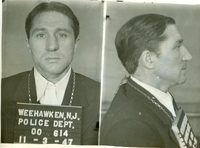 1940s Weehawken Mug Shots A collection of Weehawken Police Department mug shots from the 1940s. We don't have any information on who these people were or what they were accused of doing.
-
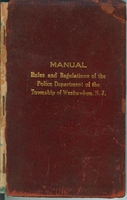 Weehawken Police Department Manual This manual was issued to all members of the WPD during the tenure of Mayor Charles Leech (around 1924). It provided the Weehawken policeman with rules, regulations, ordinances and more.
-
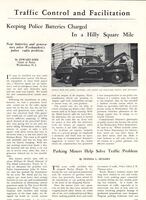 Keeping Police Batteries Charged in a Hilly Square Mile This article, written by Weehawken Police Chief Edward Kirk, appeared in the November, 1946 issue of The American City magazine, in the ever popular Traffic Control and Facilitation section. It describes how the problems caused by those new fangled police car radios were solved by the addition of new, stronger batteries. The article includes a photo of the Chief along with a police mechanic in front of a 1946 WPD squad car. From:The American CityNovember, 1946 Traffic Control and Facilitation: Keeping Police Batteries Charged In a Hilly Square Mile New batteries and generators solve Weehawken's police radio problem. By EDWARD KIRKChief of PoliceWeehawken. N. J. In 1943 we installed our first radio communication system: FM Motorola equipment in three Ford patrol cars, a detective squad car, an ambulance, and an emergency truck. At that time we had only thirty-five men,and our work had tripled. We found the new communication system most timely. Following the installation of radio,however, we had a persistent headache, caused not by the radio equipment but by the fact that the car batteries and generators were unable to carry the e1ectrical load. The generator would not, or could not, give the battery sufficient amperage at idling speed. Instead of the prescribed thirty,they were giving five to ten with the motor idling. Weehawken, with a population of 15,000, is only a mile square, with short streets that vary in elevation from 2 to 200 feet above the Hudson River. The town is all uphill and downhill and has no long lazy runs for battery charging. With motors running twenty-four hours a day,the batteries still ran down, a car was out of service every other day, and a generator burned out in two months' time. Our battery service man told us about William H. Hand, Director ofThe Hand Laboratory, Nyack. N. Y.,and we discussed the problem with Police Commissioner John H. Schuster, who has sparked the department for six years. Mr. Hand put his 65ampere-per-hour heavy-duty storage batteries in our cars and recommended the installation of alternating current generators made by The Leece-Neville Company of Cleveland. These, in combination with rectifiers and voltage regulators of the same make, are designed for 6-volt or 12-volt systems with an output of 60 amperes. These installations solved our problem in August 1946 with tremendous savings in motor wear, oil, and gasoline. The patrol cars are on duty at school crossings 3V, hours a day. Their motors used to be kept running. With the Hand battery and the Leece-Neville alternator, the car motor is turned off and the radio left on. Even with the motor at slow idle, the alternator feeds the battery 30 amperes when the battery is not fully charged. To facilitate car repairs, formerly done at a private garage, we employed a mechanic and built him an up-to-date shop at Commissioner Schuster's suggestion. A service for the citizen which the commissioner has sponsored is free transportation in our police ambulance if a resident must be rushed to the hospital. Also. he has installed a modern records system which includes an up-to-date card file of every person living in Weehawken. The department furnishes photostats of discharge papers free of charge to returned veterans. Commissioner Schuster's philosophy of public service has become the action of the Weehawken Police Department.He said to us: "When anybody comes to the Police Department for information, never say you don't know. If you don't know, find out. Make it your business to sell your services to all citizens in a polite, pleasant, and efficient manner."
-
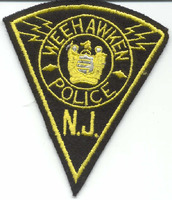 Weehawken Police Department Patch This is a vintage Weehawken Police Department patch. Any information as to what years this patch was in use would be appreciated.
-
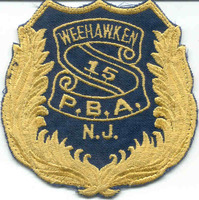 Weehawken PBA Patch Sew on emblem of the Weehawken chapter of the Police Benevolent Association (local 15).
-
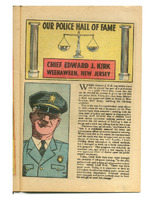 Police Hall of Fame - Chief Edward J. Kirk This two page profile from the October 1949 issue of True Crime Stories focuses on Weehawken Police Chief Edward Kirk. It begins: When Edward J. Kirk was twelve years old, he played the part of a policeman in a grade school play. From that day forward, he decided he wanted to grow up and join the police force. Thirty five years later, Edward J Kirk was appointed Chief of Police in Weehawken, New Jersey, fulfilling his life long dream.