
Items
Tag
business
-
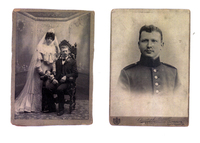 Wedding and Individual Portrait - Robert Reiner - Textile Machine Factory Owner Black and white photographs of Robert Reiner's wedding and Reiner in uniform in Germany. Robert Reiner was born in Nuertingen, Germany and left his home town for the United States around 1900. He established a textile machine company on the corner of Hackensack Plank Rd and Gregory Avenue in Weehawken. Mr. Reiner was an honored citizen of Nuertingen because he supported building up the city's hospital, gave money for the church bells, provided milk for poor children and so on. Mr. Reiner was one of the first people to cross the Atlantic by Zeppelin and served as the president of the American- German Chamber of Commerce and was awarded highest honor given to a non head of state for his work in German- American relations.
-
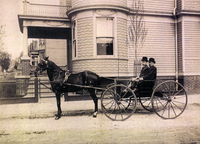 Robert Reiner - Weehawken Textile Machine Maker Black and white undated photo of Robert Reiner and unidentified person in horse and carriage on unidentified street. Robert Reiner was born in Nuertingen, Germany and left his home town for the United States around 1900. He established a textile machine company on the corner of Paterson Plank Rd and Gregory Ave in Weehawken. Mr. Reiner was an honored citizen of Nuertingen because he supported building up the city's hospital, gave money for the church bells, provided milk for poor children and so on. Mr. Reiner was one of the first people to cross the Atlantic by Zeppelin and served as the president of the American- German Chamber of Commerce and was awarded highest honor given to a non head of state for his work in German- American relations. Click the link for the back of this item below to see Mr. Reiner in his office. Thank you to Michael Weber of Nuertingen, Germany for this photo and information about Robert Reiner.
-
 Robert Reiner - Weehawken Business Owner Thank you to Michael Weber of the City Council of Nuertingen, Germany for this photo and information about Robert Reiner and his connection to Weehawken... Robert Reiner was born in Nuertingen, Germany and left his home town for the United States around 1900. He established a textile machine company on the corner of Paterson Plank Rd and Gregory Ave in Weehawken. Mr. Reiner was an honored citizen of Nuertingen because he supported building up the city's hospital, gave money for the church bells, provided milk for poor children and so on. Mr. Reiner was one of the first people to cross the Atlantic by Zeppelin and served as the president of the American-German Chamber of Commerce and was awarded highest honor given to a non head of state for his work in German- American relations. Click the link for the back of this item below to see one of the projects that Mr. Reiner funded in his home town after coming to Weehawken.
-
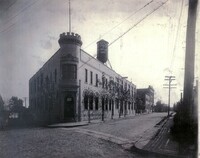 Robert Reiner's Textile Machine Factory Thank you to Michael Weber of the City Council of Nuertingen, Germany for this photo and information about Robert Reiner and his connection to Weehawken... Robert Reiner was born in Nuertingen, Germany and left his home town for the United States around 1900. He established a textile machine company on the corner of Paterson Plank Rd and Gregory Ave in Weehawken. Mr. Reiner was an honored citizen of Nuertingen because he supported building up the city's hospital, gave money for the church bells, provided milk for poor children and so on Mr. Reiner was one of the first people to cross the Atlantic by Zeppelin and served as the president of the American-German Chamber of Commerce and was awarded highest honor given to a non head of state for his work in German- American relations. Second photo shows some of the workers in the factory.
-
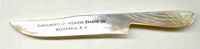 Mother of Pearl Letter Opener Small mother of pearl letter opener inscribed: Compliments of Peerless Granite Co. Weehawken, NJ, The company erected a new factory in Weehawken in 1906 and manufactured "the only genuine granite Weehawken Laundry Tub." The tubs were made from Portland cement and crushed traprock and guaranteed to be "absolutely sanitary."
-
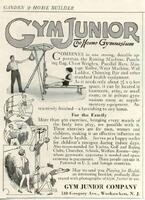 Gym Junior - The Home Gymnasium Advertisement for the Gym Junior Home Gymnasium, an all in one exercise machine made by the Gym Junior Company of 540 Gregory Avenue, Weehawken. Ad is from Garden and Home Builder but is undated.
-
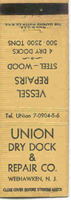 Matchbook - Union Dry Dock Advertising matchbook for the Union Dry Dock & Repair Co., located on the Weehawken waterfront, adjacent to Pershing Road. The company was incorporated in 1908 and later moved to Hoboken's waterfront.
-
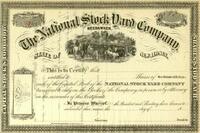 Stock Certificate for The National Stock Yard Company Blank certificate (numbered 236) for the stock of this Weehawken based company. Shares of the company cost $100 each and $1,000,000 worth of shares were issued. Incorporated in 1869, the business consisted of real estate, cattle yards and buildings in New Jersey, near the Hudson River. The Erie Company bought the property and constructed the cattle yards and buildings, and transferred it to the National Stockyard Company in 1873. The company was merged in 1883 when consolidated with the Midland Terminal and Ferry Co and with the Open Cut and General Storehouse Co. The company__s yards were along Baldwin Avenue in Weehawken. Cattle was brought in by the train load from the west for the New York markets. This cattle was unloaded and placed in long sheds until time for shipment to New York. It was then driven down Baldwin Avenue, and across a bridge that went over the railroad tracks and on to the cattle boats which were moored at the dock at foot of Baldwin Avenue.
-
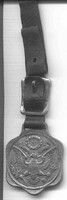 Patriotic Key Fob This appears to be an early 20th century promotional key fob. The front has the Great Seal of the United States and the reverse has the follwing text: America First Emblem of Our Glorious Country The Seal of the United States of America Compliments of Robert Reiner Importing Co. Weehawken, NJ
-
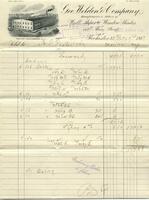 Bill from Geo. Weldon and Company Dated February 7, 1899, this bill is from Geo. Weldon and Company, Manufacturers and Jobbers of Wall Paper and Window Shades. While the company was headquartered in Rochester, NY, the billhead has an engraving of the firm's factory here in Weehawken, NJ. Thanks to Bernie Zempolich for this informative graphic.
-
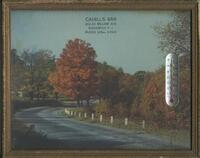 Advertisement for Cahill's Bar This framed advertisement for Cahill's Bar at 1831-33 Willow Avenue features a beyootiful colored photo of a country road which looks like it is nowhere near Weehawken. It makes up for this by providing a useful thermometer. We received this information from Mike Cahill... "I was born in Weehawken in 1945 and my family lived above Cahill's Bar until I was about 5 years old. The bar was owned by my great uncle, 'Mickey' Cahill. He lived in Weehawken on Hudson Place I believe. He was my father's uncle and my grandfather (Matthew Cahill) worked as the bartender. My meager recollection is that the establishment got plenty of business from the longshoremen who worked the piers on the river and the locals from the Shades. I do not remember much about the physical setup other than there being the standard bar and brass foot-rail. My father (Robert M. Cahill) later went on to become the Fire Chief in the mid-1960's." Time Machine user Jim Chieco sent this in... "As a kid I spent a lot of time drinking soda's in Cahill's Bar. My close friend Ray Huelbig's Dad Mickey Huelbig (Both members of the Weehawken HS Athletic Hall of Fame) was a Bartender there for a number of years and Ray and I used to play a lot of basketball in the Lincoln School Yard and then go to the bar to cool down. They had a great jukebox and I remember Bobby Darin's Mack The Knife being played all the time. (Bobby Darin was the big star of the 1959 Weehawken Centennial celebration at the show at Weehawken Stadium at the end of the week's celebration)
-
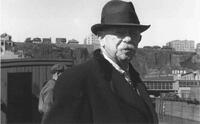 Submarine Inventor Simon Lake in Weehawken Black and white photograph (1937) of Simon Lake, submarine inventor against the background of the Palisades in Weehawken.
-
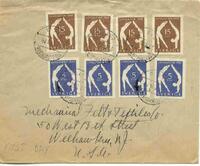 Envelope addressed to Mechanical Felt and Textiles Co. This envelope was sent from the Carlton Hotel in Stockholm to: Mechanical Felt and Textiles Co. 50 West 18th Street Weehawken NJ USA It is postmarked July 27, 1930.
-
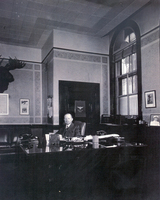
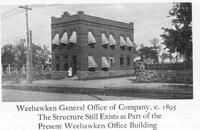 Weehawken General Office of the Hackensack Water Company Black and white photograph of the general gffice of the Hackensack Water Company in 1895 from the book, The Hackensack Water Company 1869 - 1969 by Adrian Leiby and Nancy Wichman - published in 1969 by the Bergen County Historical Society.
-
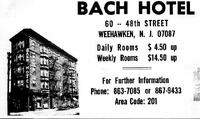 Bach Hotel Advertisement for the Bach Hotel at 60 48th Street - rooms for $4.50 a day or $14.50 a week. It later became the Park Avenue Hotel was located on the northeast corner of 48th Street and Park Avenue. The building was demolished in 2009 to make way for a senior housing project which broke ground on March 5, 2012 and opened in February, 2016.
-
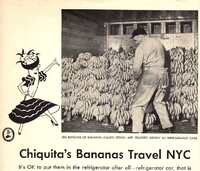 Chiquita Bananas Travel NYC Article from the April, 1953 issue of the New York Central Railroad Headlight Newsletter featuring the Banana Building on the Weehawken waterfront... Text of the article: BIG BUNCHES OF BANANAS, CALLED STEMS: ARE STACKED GENTLY IN REFRIGERATOR CARS Chiquita's Bananas Travel NYC It's OK to put them in the refrigerator after all-refrigerator car, that is YOUR old friend, Chiquita Banana, is a steady customer of the Central. Chiquita is now moving almost all her bananas for the northeastern United States through the Central's freight terminal at Weehawken, N. J., where her boss, United Fruit Company, is operating the world's biggest mechanical banana-handling facility. The Weehawken banana terminal can handle 8,000 stems (as the big bunches of fruit are called) of bananas an hour, moving them from ships' holds directly to waiting refrigerator cars supplied from NYC's adjacent Weehawken freight yard. The banana terminal can hold 72 cars on its inside tracks and has storage tracks outside for another 144. Each week-night a solid train of banana-loaded cars heads out of Weehawken, arriving next morning at Buffalo. From Buffalo, the cars of fruit are fanned out to various parts of the Central System and to other railroads. Fruit moves quickly from ship to rail Ships loaded with the tropical fruit dock beside the 1,000-foot-long terminal, which was built by the Central and leased to United Fruit on a long-term basis. As soon as a ship is tied up, giant gantry cranes dip down into the holds and the bananas start to travel up endless conveyor belts that deposit them inside the terminal building, on a novel device called a "curveyor." The curveyor is a form of belt conveyor that can travel 200 feet a minute, around curves, along loading platforms to the freight cars, and then back again to pick up more bananas as they come from the ship. Chiquita must blush to see bananas put in a refrigerator car, considering her repeated warnings on radio and television that you "should never put bananas in the refrigerator." Good reason for it There's a sound reason behind it, though. Bananas are picked before they are fully ripe. The idea is to get them to market just as they reach their prime. Warm temperatures cause bananas to ripen fast, while cold retards the process. But if they get too cold, they are spoiled. The lowest temperature bananas can safely stand is 52 to 54 degrees. Most home refrigerators are kept at temperatures considerably below this and thus would damage the fruit. In hot weather, bananas are kept cool in iced cars, so they won't be over-ripe when they reach your fruit stand. Temperature control for the fruit works both ways. When it's very cold outside, the cars are pre-warmed with small kerosene heaters before they are loaded. To prevent spoilage through freezing enroute, hot charcoal is kept in the bunkers of the cars, normally used for ice. Bananas nearest their peak ripeness when they arrive at Weehawken are taken by truck from the terminal to local area markets. The curveyor also prevents damage to the delicate fruit. The less handling the better for bananas, which bruise easily, with each bruise lowering the quality.
-
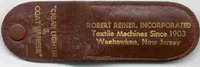 Cigar Lighter and Coat Hanger - Novelty A business promotional item from Robert Reiner, Incorporated - Textile Machines since 1903. This small leather pouch contains a match and a nail.
-
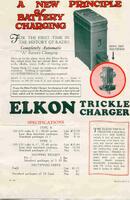 Advertisement - Elkon Battery Chargers A two sided advertisement for Elkon battery chargers, manufactured at the Elkon works right here in Weehawken. The company was located on Gregory Avenue in the 1920s.
-
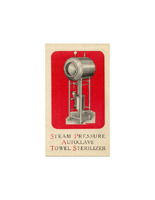 Steam Pressure Autoclave Towel Sterilizer 3 page product brochure for a towel sterilizer manufacured by S. Blickman Inc. of Weehawken.
-
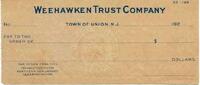 Check from the Weehawken Trust Company A blank check of the Weehawken Trust Company from the 1920s - located in Union. Not surprising, back in the ealier days, when town boundaries seemed to be more fluid. The Weehawken Post Office was also located on 38th Street in Union City for many years.
-
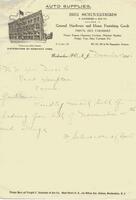 Big Schneiders General Hardware Letterhead from Big Schneiders Hardware at 82-86 Bergenline Avenue, but listing the Weehawken Post Office as a return address. Handwritten letter asking a supplier to send a bill of lading for a shipment.
-
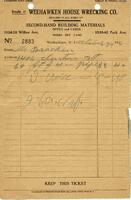 Receipt - Weehawken House Wrecking Company A handwritten receipt from the Weehawken House Wrecking Company of 1934-38 Willow Avenue. A Mr. Bracken bought 60 feet of pipe for $8.40.
-
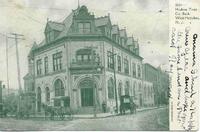 5834 - Hudson Trust Co. Bank - West Hoboken, NJ Undivided black and white postcard of Hudson Trust Bank Co., on Bergenline Avenue at 32nd St. It is now the Trust Co. Postmarked January 3, 1903 from New Durham.
-
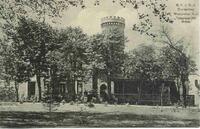 NY & NJ Crematory - Weehawken, NJ - Telephone 219 Union A black and white postcard photo of an institution that Weehawkenites were just dying to get into. Actually located at 4101 Kennedy Boulevard in North Bergen, NJ. Was originally Becker's Castle, enlarged in 1907. Currently called Garden State Crematory. Stamped September 19, 1958 on reverse with text, but never mailed.
-
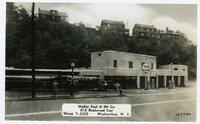 Muller Fuel and Oil Company Black and white photograph of gas station, located at 612 Boulevard East, the site of current day Speedway Gas, just north of the first Weehawken exit coming off of the westbound helix. Henry Muller started his business in 1925 with a single and expanded to operate a fleet of trucks at his premises at 612 Boulevard East (site of the current Speedway Gasoline Station.) The company delivered fuel oil, sold gasoline at the pump and industrial and domestic oil burners. He was also a real estate investor.