
Items
Tag
waterfront
-
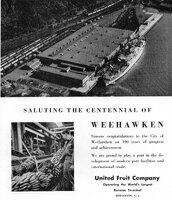 United Fruit Company Ad for Centennial Advertisement from the Weehawken Centennial Souvenir Journal. United Fruit Company congratulates Weehawken on its 100th anniversary. The banana building and pier, with its low, flat profile remained a landmark on the Weehawken waterfront for more than 50 years, from 1952 until it was demolished in 2005. From the collection of the Weehawken Historical Commission.
-
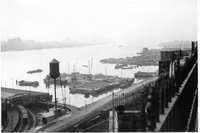 Pier K from Hamilton Avenue Black and white photograph of Pier K and its distinctive water tower, taken from Hamilton Avenue, The pier, part of the NYCRR system was located between the banana pier and Union Dry Dock, servicing trains, trucks, barges, ships. It burned in a fire in 1972.
-
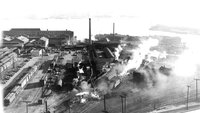 Waterfront and Rail Yards in the 1940s Photograph of the Weehawken waterfront and rail yards in the 1940s. From the collection of the Weehawken Historical Commission.
-
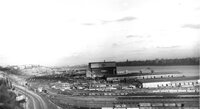 Waterfront Grain Elevator from Hamilton Park Black and white undated photo looking north across the waterfront, railroads and ferry terminal towards the Pier 7 Grain Elevator in West New York. The elevator, built in 1905 for the West Shore line of the NYCRR, had a capacity of 2 million bushels and stood 160 feet high. From the collection of the Weehawken Historical Commission
-
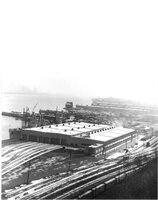 The Banana Pier and Boat United Fruit From the collection of the Weehawken Historical Commission.
-
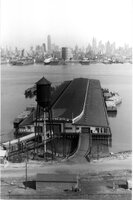 Weehawken Waterfront - Pier K Seen from Hamilton Plaza in the 1950s, New York Central Railroad's Pier K with its distinctive water tower was a longtime fixture on the waterfront. Situated between the banana pier and Union Dry Dock, it served trains, trucks, barges and ships. The pier burned down on June 10, 1972. From the collection of the Weehawken Historical Commission.
-
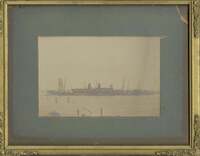 Photograph - Ship being scrapped at Weehawken This photograph shows either the Bremen or the Main being scrapped on the Weehawken flats after it burned in the great Hoboken fire of June 30, 1900. This image is courtesy of Billy Rapacki, a Weehawken resident who spotted it at a yard sale.
-
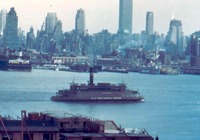 Electric Ferry Niagra This colored photo comes to us from Eileen Kelly whose father, Mark Kelly, worked for the New York Central's West Shore Railroad at night while he was still in High School (where he caught a few winks on occasion). One of Eileen's grandfathers, William O'Donnell was a railroad man as well and the other was a longshoreman on the Hoboken/Weehawken waterfront.
-
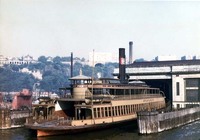 New York Central Ferry Stoney Point Photograph of the New York Central Ferry Stoney Point at Weehawken found on the excellent RailFan web site.
-
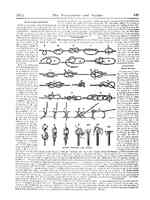 The Largest Passenger Elevators in the World Article from The Manufacturer and Builder, November 1891. The Largest Passenger Elevators in the World. The largest elevators, for carrying passengers, in the world, have just been completed on the banks of the Hudson, near Weehawken. The high table- land in New Jersey, opposite New York city, amid between the Hudson River and the Hackensack, has, up to to this time, not been used as generally for purposes of pleasure and residence as it should have been. This elevated plain, known as the Palisades, is at its beginning some one hundred and fifty feet above high tide, and is over a mile wide at the same point. It stretches north for many miles up the Hudson River, and naturally rises in elevatlon as it proceeds. This high land has been accessible only by steep grades for wagon roads, and by means of stairways which climbed laboriously up the steep cliff. The Hudson County Railway Company, which operates the elevated road at Hoboken, and controls many of the street-car lines in that neighborhood, has of late years been extending these lines and increasing the facilities for getting on top of the Palisades, and from one point of this high plateau to another. The most recent addition to the plant of this company has been the building of huge elevators at Weehawken, where the ferryboats from Forty-second and Jay streets, New York city, discharge their passengers, and where, also, the West Shore Railway starts north and west to Albany and Buffalo. These elevators are the largest ever constructed for passengers, and in planning them the engineers have adopted new devices to secure their safety against accidents. From the elevators, which rise just from the water's edge, there is an immense viaduct, or elevated railroad, which runs some eight hundred feet back to the hill, where connections will be made with the various steam and horse cars which will run in one direction and another. Harper's Weekly.
-
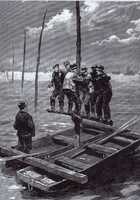 Shad Fishing, Weehawken This is a reproduction of an engraving from Frank Leslie's Illustrated Newspaper of April 14, 1888. It shows fishermen planting poles in the Hudson River bottom in order to string nets.
-
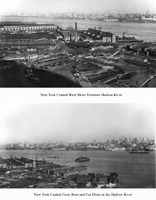 Photos of the Weehawken Rail/Ferry Terminal - 1930s These photos, as well as the description below, were posted on the www.railfan.net site by 'waterlevel,' the moderator of the forum which deals with the New York Central's Marine Operations: Photographed from the Weehawken bluffs the photos were taken in the late 1930's. The Rochester is seen in the ferry slip and two New York Central tugboats are approaching the yards in the middle of the first photo. Just below the large smokestack is a dark building that was the Public Service trolley shed. To the left was where Railway Express operated out of. On the upper left were where the railroad boxcars waited to be loaded onto the car floats and beneath them are the New York Central passenger cars for the West Shore Line. There was a diner located in the trolley shed and just up the street was a place for the workmen to buy their work clothes. Inside the railroad terminal was a large waiting room with long wooden benches and a news stand that sold newspapers, magazines, candy and other items to the commuters. It was run by the Union News Company. Within a few years this terminal was critical to the WWII effort in moving tanks, artillery, ambulances, jeeps, duce and a halfs and other war material to waiting ships in the Port of New York. Many Army personnel saw their last of America from this spot since the trains brought them from New York State through New Jersey and then by ferry to the troop transports. In four years the ferries would be the in the transport loop once again by ferrying prisoners of war to the holding camps in New York. In 1927 the ferries carried 27,044,102 people crossing the Hudson by ferry. By 1954 the number had dropped to 429,588 people. The ferries closed down in 1959.
-
 The Hudson From The Wilderness to the Sea The Hudson from the wilderness to the sea by Benson J. Lossingpublished by Virtue & Yorston - New York , 1866 This link is part of the New York Public Library's digital collections. Thanks to Willie Demontreux for this link.
-
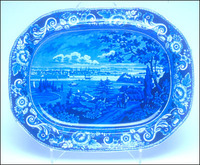 View of New York from Weehawken - Platter Earthenware platter with view of New York City from Weehawken, NJ, by Andrew Stevenson, Staffordshire, England, 1820-1829. From the Collection of the New York Historical Society.
-
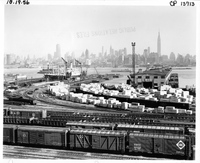 Photo of Erie Railroad Weehawken Terminal - 1956 Tom Flagg, who provided this image and associated information writes: This is a photo of the Erie Railroad's Weehawken waterfront terminal, facing east, dated 10-19-1956. It is from the Port of New York Authority's Public Relations files (as the stamp in the sky reveals). The piled boxes are crated export machinery awaiting the call to be transferred to barges, which will then deliver them to ships anywhere in the Port.
-
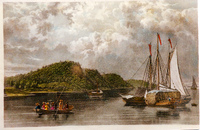 View of Weehawken Bluff from the Hudson This steel engraving was published on February 24, 1844 in the New Mirror (a periodical published in New York). The artist was William James Bennett. The view looks north towards the Palisades. Highwood, the home of James Gore King, is seen center. Click here for a larger version of this image. This image and the information above were both provided by Tom Flagg.
-
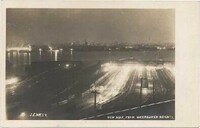 New York from Weehawken Heights This image was provided by Tom Flagg, print collector and industrial archaeologist from across the river in NYC. He provided the following information about this picture: Copy of an aquatint, printed in colors, 17-7/8" x 12-7/8", in Vues des Cotes de France dans L'Ocean et dans la Mediterranee, a collection of views mainly of French ports. This was in the fifth volume and probably dates from 1834. The artist was Louis Garneray and the engraver was Sigmund Himely, but apparently neither had visited the U.S., so theye were presumably working from someone else's sketch. Some authors have speculated they were copying Milbert's view.
-
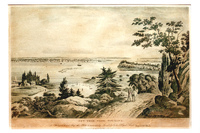 New York from Weehawk - 1823 This image was provided by Thomas Flagg, a print collector and industrial archaeologist from across the Hudson in New York. He writes: This print is titled "New York from Weehawk" and was published in 1823;it was painted by Wall and engraved by Hill. It was originally an aquatint, but was reprinted/reproduced later as a steel engraving and in other media. Then in the late 1920s it was reissued as an aquatint by Margolies, somewhat larger than the original; that is the version I owned and which this is a copy of, photographed extremely fine grain neg. film(Ektar 25) and made into a PhotoCD image, and here converted by me into ajpg. This was the earliest published version of the view from Weehawken that I know of, and it seems to have been the inspiration for many of the other views that came along later.
-
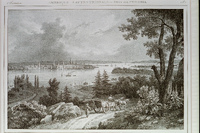 View of New York from Weehawken by Milbert This image was provided by Tom Flagg, a print collector and industrial archaeologist hailing from across the Hudson in NYC. He writes: View of New York Taken from Weehawk is No. 1 in Milbert's book, Itineraire Pittoresque du Fleuve Hudson (Picturesque Itinerary of theHudson River), a book of black-and-white lithographic prints published inFrance (by Henry Gaugain) in 3 volumes, 1828-1829. These lithographs were based on drawings made by Jacques Gerard Milbert during his stay in the United States between 1815 and 1823 and were reprinted many times in the 19th century by various publishers.
-
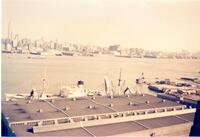 View of the Banana Pier and Skyline - 1965 Black and white photo of the Banana building and the NY skyline IN 1965. From the collection of Leo Her via Thomas Cheplic.
-
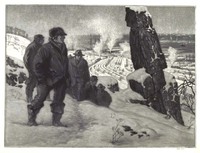 Engraving - Above the Yards, Weehawken Engraving by Martin Lewis, circa 1918. Only 15 copies of this engraving were made. The original is approximately 17 by 23 inches in size and is currently being offered for sale by The Old Print Shop in NYC (www.oldprintshop.com) for $15,000.
-
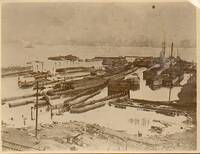 Photo: Ship Graveyard at Weehawken The caption of this black and white photo reads: Weehawken has ship graveyard! Along a goodly stretch of the West bank of the Hudson River, just north of Weehawken, New Jersey is to be found a typical graveyard - the last resting place for forgotten ships. Here vessels that done good service in their day have fought their way through wind and weather, have found a last resting place. A general view of the abandoned ships. Date - 1920s or 1930s.
-
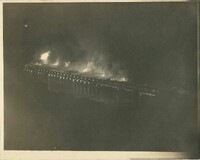 Weehawken Pier Fire This black and white photograph shows a burning pier on the Weehawken waterfront. It was sent in to the Time Machine by Dennis Cosgrove, who places it as having been taken around 1948. Pretty close - according to the New York Times (Jan 10, 1947, p. 14) , the fire burned for 26 hours on January 8-9, 1947 and destroyed about $3 million in merchandise. The fire was caused by chemicals leaking from a train into some water and igniting.
-
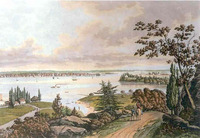 New York from Weehawken - 1822 Engraved by G. E. after a picture by Louis Augier, looking south towards New York City, from Weehawken and dated 1822. The original engraving is approximately 18 x 22 inches.
-
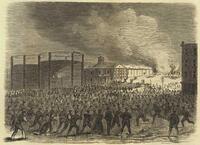 Destruction of the Weehawken Ferry House Engraving from Frank Leslie's Illustrated Newspaper of August 1, 1863, showing participants in the New York Draft Riots of July 15th, 1863 burning down the New York terminal of the Weehawken ferry in an effort to stop Federal troops from entering the city. Submitted by Bob Schwartz