
Items
Tag
public safety
-
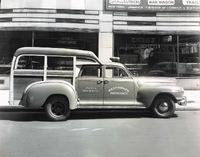 Weehawken Ambulance from the 1940s This photo shows a very 1940s looking ambulance marked "Weehawken Emergency" and "Donated by Robert Reiner" standing in front of the dealer from which it was sold. The dealership, which was located in Brooklyn and Mineola, NY, is the subject of photograph number two. This is waaay before the days of the Weehawken Volunteer First Aid Squad (which started in 1969), so it is likely that this vehicle was run either by the Weehawken Police of Fire Department or North Hudson Hospital. Robert Reiner was the owner of a large embroidery firm located on Hackensack Plank Road and it is good to see evidence that he was a good citizen and helped the town. If you have more information about this ambulance, we'd love to hear about it!
-
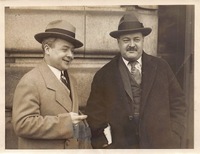 Photo - Weehawken Police Commissioner Harry Stearns and his attorney Caption: N 74583 "P & 4 PHOTOS"WATCH YOUR CREDIT (PHOTO SHOWS L to R HARRY STEARNS, POLICE COMMISSIONER OF WEHAWKEN, N.J., AND HiS ATTORNEY, CHARLES STUHR) INFORMER IN JERSEY RUM SCANDAL SWEARS HE SAW FOLICE HEAD CHECKING RUM LOADFATHER BENNETT FLASHED A POCKET LIGHT ON THEM AND WE BOTH RECOGNIZED A MAN WHO WAS ENGAGED IN COUNTING AND CHECKING OFF THE CASES OF LIQUOR AS HARRY J . O S' HAUGHNESSY STEARNS, POLICE COMMISSIONER OF WEEHAWKEN," SAID CHARLES D. KIRK, REPUBLICAN POLITICIAN OF WEEHAWKEN, N.J., IN AN AFFIDAVIT WHICH EXPOSED HIGHER-UPS IN THE JERSEY LIQUOR RUNNING SCANDAL. IT IS HINTED THAT FEDERAL PROHIBITION AGENTS, NEW YORK CITY POLICE OFFICERS AND OTHER JERSEY POLITICIANS MAY BE DRAGGED INTO THE SCANDAL.FM. 12-8-24According to a NY Times article (Wed, June 17, 1925), Stearns and 9 other Weehawken PD personnel were found not guilty of charges of violating the Volstead Act (Prohibition)
-
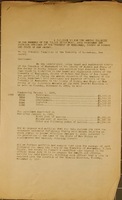 1954 Petition Regarding WPD Salaries A petition requesting pay raises for Weehawken Police Department personnel for the year 1955.
-
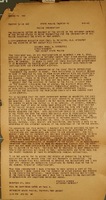 World War II NJ State Police Instructional Teletype - Limitations on radio ownership by 'enemy aliens' A teletype message from the NJ State Police in the files of the Weehawken Police Department from 1942 providing instructions as to the limitations placed on 'enemy aliens' of German, Italian, and Japanese origin regarding ownership of radio equipment. This document provides insight into the WPD's role in wartime preparedness.
-
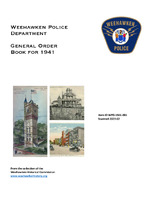 Weehawken Police Department General Order Book for 1941 Book containing department wide orders of a general nature for the year 1941 for the Weehawken Police Department. This document provides interesting insight into the Town's preparation for World War II as well as the reaction of its police department to the first days of this global conflict.
-
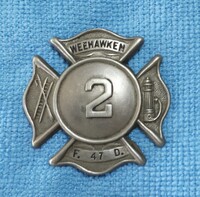 Weehawken Fireman Badge Metal fireman's badge from the Palisade Hose Company, organized in 1895 and located on Jane Street in the Weehawken Heights. The badge belonged to Frederick J. Bergmann Jr, and then to his son Frederick. The '2' on the badge stands for the Palisade Hose Company, the '47' at the bottom was the member number. According to John Bergmann, who donated the badge: "My understanding on the badge is that it started with great-grandfather when he was a volunteer & then when my grandfather joined, it was passed to him. Apparently, so the family history goes, great-grandfather was very active on Board of Freeholders somewhere in that time & since they both were on the same company, it was handed down." The badge was manufactured by the C.D. Reese Company, which was located at 57 Warren Street, New York, NY.
-
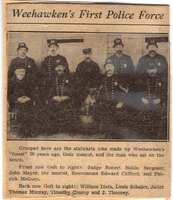 Weehawken's First Police Force Undated and unidentified newspaper clipping of a photo of Weehawken's first police department and their mascot. Front row (left to right): Judge Robert Noble Sergeant John Mayer the mascot Roundsman Edward Clifford Roundsman Patrick McGoey Back row (left to right): William Dietz Louis Schafer Jailer Thomas Murray Timothy Conroy J. Timoney This item is in the collection of the Weehawken Historical Commission.
-
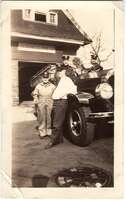 Photo - 1940 - Men of Engine 4 Black and white photo of members of the Weehawken Fire Department in 1940. There is a hand written caption on the reverse of the photo naming the people in the picture. From left to right:Captain Pat Duryer - coveralls, Deputy Chief Reeves - white shirt, Joe Cusick - sitting left, Rich Brinkman - sitting right. Engine # 4 Duer Place Fire Department Headquarters. 1928 Maximum Fire Truck Pumper (Best pumper made). 2005000021,Newspaper Clipping - Super-Highway in Old Highwood,Undated and unidentified newspaper clipping describing the history of the King family of Highwood Park and Kingswoods sections of Weehawken.
-
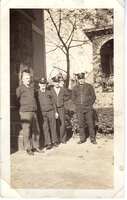 Photo - Men of Engine 4 - 1940 Black and white photo, dated 1940 with a handwritten caption on the reverse. From left to right: Driver Rich Brinkman Captain Patty Duryea Nozzle Man John Bradley Chief's Driver Joe Cusick This photo is labeled Engine #4 - Duer Place - Fire Headquarters. This item is in the collection of the Weehawken Historical Commission
-
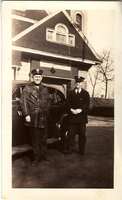 Photo - 1940 - Deputy Fire Chief Reeves and Joe Cusick Black and white photo of Deputy Fire Chief Reeves and his chauffeur, Fireman Joe Cusick standing in front of Engine 4 on Duer Place. This item is in the collection of the Weehawken Historical Commission.
-
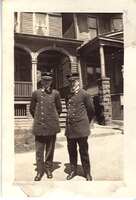 Photo - 1937 - Fire Chiefs Ryan and O'Neill Black and white photo showing Fire Chiefs Ryan (Left) and O'Neill (Right), Engine No. 4, standing near Fire Headquarters on Duer Place in 1937. This item is in the collection of the Weehawken Historical Commission
-
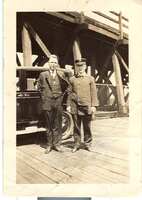 Photo - 1920s - Fire Chief O'Neill and Chauffeur Joe Cusick This black and white photo has a handwritten caption on the back reading: Under electric ferry 1920s Chief Wm O'Neill Chauffeur Joe Cusick New Chiefs Car Late 1920s
-
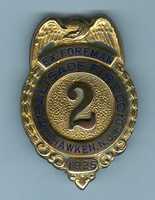 Ex Foreman Badge - Palisade Fire Company - 1925 Badge of the Palisade Hose Co No. 2. According to Willie Demontreux: The early Fire Departments ran like clubs or businesses. The hierarchy consisted of President, Vice President, Foreman (Asst Foreman) Secretary, Treasurer, then firemen in rank order. Later an engineer was added to run and operate motorize rigs (these were the first paid firefighters.) Palisade Hose Company became Weehawken Engine No. 2, with the ranks of Chief, Deputy Chief, Battalion Chief, Captain and Firefighter. The 1925 date indicates the end of the volunteer fire department, made of local residents, and becoming rank and file of the township fire department, a civil service job. From the collection of the Weehawken Historical Commission.
-
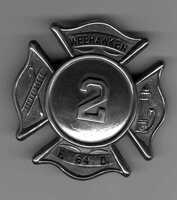 Weehawken Fireman Badge Weehawken Fireman Badge marked with a large 2 and smaller number 64. It appears that the 2 is the unit number and the 64 is the badge number. There is no indication of the date that this badge was in use. From the collection of the Weehawken Historical Commission.
-
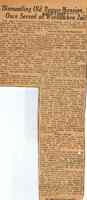 Dismantling Old Roman Mansion, Once Served as Weehawken Jail Clipping from an unidentified newspaper (probably the Hudson Observer) stamped March 21, 1947 and describing the demolition of 1 Hackensack Avenue in The Shades. This building was Weehawken's first Police HQ and Jail in 1870. The article provides a number of details about Weehawken's early law enforcement and hospitality communities.
-
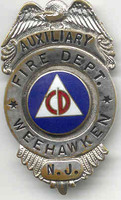 Badge - Weehawken Civil Defense Fire Department Silver badge reading 'Auxiliary Fire Department - Weehawken N.J.' with an enameled Civil Defense emblem. This badge was donated to the Weehawken Historical Commission by its owner, who was a member of the department in the 1950s. The back of the badge reads 'S.H. Reese, 57 Warren Street, New York,
-
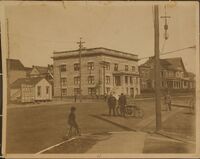 Policemen at 4th Street (48th Street) and the Boulevard This photo from the early 1900s shows Patrolman Sy. Clute of the Weehawken Police Department and Boulevard Officer Patrick Dolan, who later became chief of the Hudson County Police Department. It was taken at the corner of 4th Street (today's 48th Street) and Boulevard East.
-
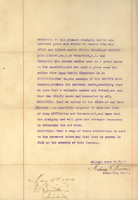 A Tribute from the Baldwin Hose Co. A resolution of tribute in memoriam of Thomas Wright, a member of the Baldwin Hose Company, dated May 3, 1910. From the collection of Mark Wright.
-
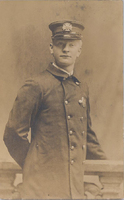 Peter Scentel Undated sepia toned photograph of Peter Scentel, a member of the Baldwin Hose Company and also Sunday School Superintendent of the W. 19th St. Methodist Episcopal Church. From the collection of Mark Wright.
-
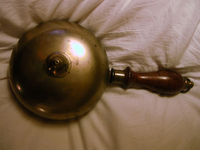 Fire Bell Metal firebell with wooden handle, circa 1900. From the collection of Mark Wright: "My great Grandfather Thomas Wright's firebell which he rang through the streets of the Shades to summon other firemen to pull the old fire engine to a fire."
-
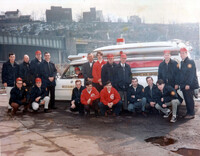 Weehawken's First Ambulance - 1969 This color photo shows the members of the Weehawken Volunteer First Aid Squad with their shiny new Cadillac ambulance in 1969, when the squad was born.
-
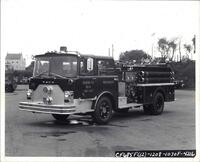 Weehawken Fire Department Engine 4 This photo came to the Time Machine from Ken Mc Ardle, Asst. Chief (ret.) of the Jim Thorpe Fire Department, Diligent Fire Company 3. According to Jeff Welz (of North Hudson Fire and Rescue fame), this truck dates from 1974 and was stationed at the 46th Street firehouse on Park Avenue.
-
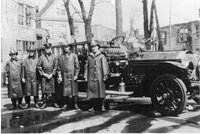 Fire Engine and Crew - Undated Black and white photograph of the Palisades Hose Company No. 2 in front of their quarters at the dead end of Jane street. According to Willie Demontreux: They are standing next to an American LaFrance fire engine, from the 1920s (models from that time tend to repeat design. It appears that the company was drilling with the engine because the street is very wet. The Firefighter in the center with the bell cap is George Walters. From the collection of the Weehawken Historical Commission.
-
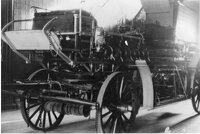 Horse Wagon - Palisade Hose Company 2 This black and photograph shows a horse drawn fire engine used by the Palisade Hose Company. Time Machine user George Browne sent in this further information: When I worked at the Jane Street firehouse in the late 1970s, there was a resident who lived at the dead-end of Jane S by the name of Freddie Klinky, Freddie was in his 60s at the time and he had lived all his life on Jane St. His father had been a member of the Palisade Hose Company when the FD was a volunteer FD and used horse drawn apparatus. According to Freddie, the Palisade Hose Company did not have horses, but instead relied on delivery men from Macys, Gimbels, etc to use their horses to pull the apparatus. According to Freddie (and he is long gone), when the fire bell sounded, the delivery men would race to the fire house, disconnect the horses from their wagons, connect them to the fire apparatus and take it to the fire. Once positioned at the fire, the delivery men would disconnect and go back to their deliveries. According to Freddie, the delivery men were paid $5 each time they hauled the hose wagon to the fire (a nice sum of money in the early 1900s) It was up to the FD to get the apparatus back to quarters after the fire. From the collection of the Weehawken Historical Commission.
-
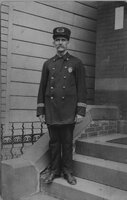 Police Captain A. Charles Hessner Police Captain Charles A. Hessner, posed on the stairs of the old town hall/police station at 309 Park Avenue, today's VFW and Historical Commission headquarters. From the collection of the Weehawken Historical Commission.