
Items
Tag
Denning Duer
-
 Memoir of Living at Hauxhurst in the 1870s A memoir written in 1945 by a granddaughter of Denning Duer, Eleanor Duer Larocque, of her years spent in Weehawken in the 1870s and 1880s. Grandfather Duer was the owner of Hauxhurst mansion which was built by his father-in-law James Gore King for his daughter, Caroline King and Denning Duer. Denning's son, James Gore King Duer, and Elizabeth Wilson Meads Duer moved their family from Staten Island to Weehawken in 1874 and lived there for 10 years until they relocated to Manhattan. This manuscript was given to Helene Hasbrouck Anderson (nee Eagan), who lived at 38 King Avenue and met the author in Bernardsville in 1950.
-
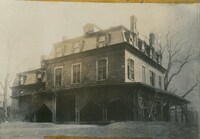 The Denning Duer Mansion in 1900 Photograph of the Denning Duer Mansion, called Hauxhurst, which stood at the intersection of the west side of Sterling Avenue and Denning Place. The photograph is dated 1900 and the caption states that "Mrs. Irving Berlin, wife of the great composer, is a grand daughter of Denning Duer. Her mother is Catherine Duer." This photo is from the collection of the Weehawken Historical Commission.
-
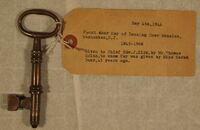 Key to Hauxhurst, the Denning Duer Mansion Front door key of the Denning-Duer Mansion, called Hauxhurst from 1845-1900. May 4, 1944. Given to Chief Edward J. Kirk by Mr. Thomas Quinn, to whom key was given by Miss Sarah Duer, 45 years ago. From the collection of Police Chief Edwark Kirk, to the collection of the Weehawken Historical Commission.
-
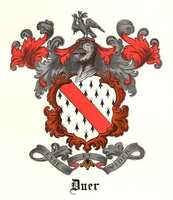 Duer Family Crest Family crest of the Duers. Both Duer Place and Denning Streets were named for William Denning Duer, banker and son-in-law of James Gore King, owner of Hauxhurst and respected Weehawken resident. His son, Denning Duer, Jr., born in Weehawken, was in banking, then became a diplomat and retired to New Haven, CT. These pages are from Representative Citizens of Connecticut Biographical Memorial, edited by Samuel Hart, D.D. and D.C.L., the president of the Connecticut Historical Society. This "edition de luxe" was published by the American Historical Society of New York in 1916.
-
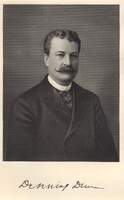 Denning Duer, Jr. Engraving and biography of Denning Duer, a distinguished US diplomat who was born September 15, 1850 in Weehawken. Both Duer Place and Denning Streets were named for Denning Duer, Sr. These pages are from Representative Citizens of Connecticut Biographical Memorial, edited by Samuel Hart, D.D. and D.C.L., the president of the Connecticut Historical Society. This "edition de luxe" was published by the American Historical Society of New York in 1916.
-
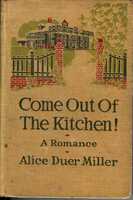 Come Out of the Kitchen! by Alice Maude Duer Born on Staten Island, New York, on July 28, 1874, Alice Maude Duer was of a wealthy and distinguished family, who, due to financial difficulties had to move in with their relative, William Denning Duer, whose estate, Hauxhurst, was located in Weehawken. She and her two sisters, Caroline and Eleanor, spent their formative years in Weehawken. The family fortune was lost in a banking failure, so Duer made her way through Barnard College by selling essays, poems, and stories to Harper's and Scribner's magazines. In 1896 her first book, entitled simply Poems, was published. In 1899, shortly after her graduation, she married Henry W. Miller, a businessman with whom she lived in Costa Rica until 1903. During that time she continued to publish magazine pieces. After the Millers returned to New York Alice Miller taught composition at a girls' school and tutored in mathematics at Barnard until 1907, while publishing The Modern Obstacle (1903), and Caldron's Prisoner (1904), the first of her many romantic novels. Thereafter she devoted herself to writing. The Blue Arch (1910), Things (1914), and Are Women People? (1915) followed. The last, a collection of satirical verses, took its title from the column she wrote for the New York Tribune from 1914 to 1917. Miller's first great success, Come Out of the Kitchen (1916), set the pattern for several subsequent novels; it was serialized in Harper's, published in book form, and then adapted for Broadway and a motion picture. She is perhaps best known for her novel in verse, THe White Cliffs (1940), which was subsequently made into a film in 1944, The White Cliffs of Dover.